Paint protection film is not made from one material alone. A finished PPF product is normally a multilayer system consisting of a protective topcoat, a transparent or colored base film, a pressure-sensitive adhesive and a removable release liner. The base film may be described as TPU, TPH or PVC, but its material name alone does not determine the product’s clarity, flexibility, weather resistance or service life.
TPU is generally used for higher-performance automotive paint protection films because it can provide a useful combination of elasticity, toughness, transparency and abrasion resistance. PVC is a more economical film material commonly associated with traditional automotive wraps and entry-level protective products. TPH is a commercial PPF term whose exact composition can vary between suppliers; it is often positioned between PVC and TPU in price and performance.
To select the right film, distributors, installers and private-label brands should evaluate the complete construction rather than relying only on labels such as “premium TPU” or “self-healing TPH.”
What Materials and Layers Are Used in Paint Protection Film?
Paint protection film is a laminated surface-protection system in which the base polymer provides mechanical strength while the topcoat and adhesive control surface durability and installation performance.
A typical automotive PPF product contains four functional layers:
| Layer | Typical Material or Construction | Main Function |
|---|---|---|
| Topcoat | Cross-linked polyurethane, acrylic-modified coating or another proprietary coating system | Controls gloss, stain resistance, hydrophobicity, scratch recovery and surface feel. |
| Base film | TPU, PVC or a commercially described hybrid material such as TPH | Provides thickness, flexibility, impact absorption, stretch and tear resistance. |
| Adhesive | Pressure-sensitive acrylic adhesive or another automotive-grade adhesive system | Bonds the film to painted surfaces while supporting positioning and long-term edge stability. |
| Release liner | Coated PET or release-treated paper, depending on product design | Protects the adhesive during coating, cutting, storage and transportation. |
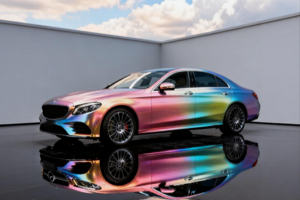
Some products may contain additional primer layers, pigment layers, carrier films or textured surfaces. Color PPF may use colored TPU, printed layers, metallic particles, pearlescent pigments or combinations of these technologies.
The topcoat is particularly important. Self-healing, gloss retention and stain resistance are primarily surface-coating functions rather than automatic properties of every TPU substrate. A low-quality topcoat applied to a good TPU base can still produce disappointing results.
What Is TPU Paint Protection Film?
TPU stands for thermoplastic polyurethane, a polymer family that combines thermoplastic processability with rubber-like elasticity. Material properties can be adjusted through changes in chemical formulation, hardness, molecular structure and additives.
Covestro’s technical overview of thermoplastic polyurethane identifies clarity, toughness and processing versatility among the characteristics available in TPU grades for film and sheet applications. These characteristics help explain why TPU is widely used in modern automotive protection films.
The principal advantages of a well-formulated TPU PPF substrate include:
- High flexibility: The film can conform to bumpers, mirror housings and other complex automotive surfaces.
- Elastic recovery: The material can stretch during installation and recover after moderate deformation.
- Tear and impact resistance: TPU can absorb energy from light road debris and daily surface contact.
- Optical potential: Suitable grades can be manufactured with high transparency and controlled haze.
- Abrasion resistance: TPU is suitable for applications requiring repeated contact and surface protection.
- Coating compatibility: The substrate can be combined with functional topcoats for stain resistance and scratch recovery.
Lubrizol’s ESTANE TPU information for paint protection film discusses clarity, protection, weatherability and manufacturing consistency in TPU-based PPF applications.
Aliphatic TPU vs Aromatic TPU
Not every TPU has the same resistance to sunlight and discoloration. One of the most important distinctions is between aliphatic and aromatic TPU chemistry.
Aliphatic TPU grades are commonly selected for visible outdoor films because they can provide better color stability and resistance to UV-related yellowing. Lubrizol describes its color-stable aliphatic TPU as suitable for applications requiring UV resistance, yellowing resistance and abrasion performance.
Aromatic TPU can offer useful mechanical properties and cost advantages, but it is generally more susceptible to discoloration under prolonged UV exposure. Buyers should therefore ask whether the supplied PPF uses an aliphatic or aromatic TPU substrate rather than accepting “TPU” as a complete material description.
What Is TPH Paint Protection Film?
TPH is commonly expanded in the PPF market as “thermoplastic hybrid,” but it is not a universally standardized polymer family in the same way as TPU or PVC. Its precise formulation and performance may differ significantly between manufacturers.
Many commercial TPH films are described as modified PVC-based films designed to provide better flexibility, surface appearance or coating compatibility than conventional PVC film. Other suppliers may use different blends, additives or proprietary constructions while applying the same TPH label.
Because the term is not sufficiently specific on its own, a buyer should not assume that two TPH films from different manufacturers use identical materials.
Potential characteristics of commercial TPH PPF include:
- Lower purchasing cost than many aliphatic TPU films;
- Improved flexibility compared with basic rigid or semi-rigid PVC constructions;
- Compatibility with gloss, matte or self-healing-style topcoats;
- Easier positioning for value-oriented product ranges;
- Shorter expected outdoor performance than premium TPU products in many formulations.
However, these are general market tendencies rather than guaranteed material properties. A TPH product may perform well in one application and poorly in another depending on plasticizer stability, coating quality, adhesive design, climate and production consistency.
For procurement purposes, the manufacturer should disclose:
- The principal polymer used in the base film;
- Whether the film is PVC-based, polyurethane-modified or made through another hybrid system;
- The type and thickness of the topcoat;
- Accelerated-weathering conditions and results;
- Expected removal behavior after outdoor exposure;
- Warranty scope and excluded failure modes.
A technical data sheet that lists only “Material: TPH” does not provide enough information for a meaningful quality comparison.
What Is PVC Paint Protection Film?
PVC stands for polyvinyl chloride, also commonly called vinyl. It can be manufactured in rigid or flexible forms by adjusting its formulation and additives. The Vinyl Institute’s overview of PVC applications notes that the material is used in both flexible and rigid products and can provide strength, water resistance and chemical resistance.
Flexible PVC has been widely used for vehicle graphics, color-change wraps, advertising films and economical surface-protection products. Its advantages include mature manufacturing technology, wide color availability, printability and relatively low material cost.
In demanding PPF applications, conventional PVC may have several limitations compared with high-quality aliphatic TPU:
- Lower elastic recovery after heavy stretching;
- Greater risk of permanent deformation around complex curves;
- Potential plasticizer migration as the material ages;
- Possible shrinkage, hardening or edge lifting after prolonged exposure;
- Lower resistance to impact and tearing in some formulations;
- Less suitable for long-term, high-clarity paint-protection applications.
This does not mean that all PVC films are poor products. PVC remains suitable for many automotive restyling and short- to medium-term applications. The correct choice depends on whether the customer primarily needs color customization, economical temporary coverage or higher-level impact protection.
TPU vs TPH vs PVC: What Is the Difference?
| Comparison Point | TPU PPF | TPH PPF | PVC Film |
|---|---|---|---|
| Material definition | Recognized thermoplastic polyurethane polymer family | Commercial hybrid label with supplier-dependent composition | Recognized polyvinyl chloride polymer family |
| Typical market position | Mid-range to premium PPF | Entry-level to mid-range protective film | Economical wrap or basic protection film |
| Flexibility | Generally high | Generally moderate, but formulation-dependent | Moderate and strongly affected by plasticizer formulation |
| Elastic recovery | Normally better for complex PPF installation | Variable | Normally lower than TPU |
| Impact protection | Usually the strongest option among the three when properly formulated | Moderate and product-dependent | More limited in conventional thin wrap constructions |
| Outdoor color stability | Good when aliphatic, UV-stable grades are used | Depends on the base polymer, additives and coating | Depends heavily on formulation, pigments and stabilizers |
| Self-healing potential | Can support advanced self-healing coating systems | May use a scratch-recovery topcoat | Possible only through a suitable surface-coating system |
| Material cost | Usually higher | Usually moderate | Usually lower |
| Recommended use | Long-term clear, matte or color PPF programs | Value-focused PPF ranges after adequate testing | Color wraps, graphics and budget-focused applications |
This comparison describes common material tendencies, not guaranteed specifications. A carefully engineered TPH film may outperform a poorly coated TPU film in selected tests. Likewise, a high-quality PVC wrap may provide better color stability than an unverified low-cost hybrid film.
Why the Base Material Is Not the Only Quality Factor
A supplier may advertise TPU prominently while providing little information about the topcoat, adhesive or raw-material grade. This can create misleading comparisons because the finished PPF behaves as an integrated system.
Topcoat Quality
The topcoat affects gloss, stain resistance, water behavior, surface smoothness and light-scratch recovery. Buyers should verify whether the coating is applied consistently across the full roll and whether it remains bonded after stretching, washing and weathering.
Adhesive Performance
The adhesive affects repositioning, silvering, edge lifting, glue lines and removal. Excessive adhesion may make installation or future removal difficult, while insufficient adhesion may produce edge failure.
Optical Clarity
Clear PPF should preserve paint depth rather than create a cloudy appearance. ASTM D1003 provides methods for measuring haze and luminous transmittance in transparent plastics.
Tensile and Elongation Properties
Stretch data should be compared using the same test method, specimen orientation and film thickness. ASTM D882 covers tensile testing of thin plastic sheeting and film below 1.0 mm in thickness.
Weathering Resistance
Outdoor performance is influenced by UV exposure, heat, moisture, pollution, washing chemicals and climate. ISO 4892-2 specifies xenon-arc exposure methods for plastics in the presence of controlled temperature and moisture conditions.
Accelerated-weathering hours should not automatically be converted into a fixed number of outdoor years. Buyers should compare test conditions, irradiance, temperature, moisture cycles and measured changes in color, gloss, tensile properties and adhesion.
How Should B2B Buyers Verify PPF Material?
Distributors and private-label brands should verify material identity through documents, samples and performance testing rather than depending entirely on product names.
- Request the substrate description. Confirm whether it is aliphatic TPU, aromatic TPU, PVC or a supplier-specific hybrid.
- Ask for raw-material traceability. A manufacturer should be able to identify the substrate batch and production lot.
- Review a complete technical data sheet. It should include total thickness, base-film thickness, elongation, tensile strength, haze, gloss and adhesion.
- Check the testing conditions. Test results without methods, units and sample preparation are difficult to compare.
- Conduct installation trials. Test the film on flat panels, deep recesses, bumpers, edges and dark-colored paint.
- Evaluate aged samples. Compare new material with samples exposed to UV, heat, moisture and cleaning chemicals.
- Confirm removal behavior. Ask for evidence of adhesive stability and clean removal after controlled aging.
- Inspect different batches. One perfect sample does not prove long-term production consistency.
SolarDe’s clear paint protection film range includes different thickness and performance options for automotive protection projects. Businesses developing their own product lines can also review SolarDe’s OEM and ODM automotive film services for specification matching, private labeling and customized packaging.
Which PPF Material Should You Choose?
TPU is generally the preferred base material for brands targeting high-clarity, flexible and longer-term paint protection products. Aliphatic TPU is especially relevant where outdoor color stability is a major requirement.
TPH may be considered for value-oriented product lines, but the buyer must investigate what the term represents in the supplied product. PVC remains suitable for many color-wrap and short- to medium-term applications where price, printability and color selection matter more than maximum elasticity or impact protection.
A practical product portfolio may include:
- Premium aliphatic TPU PPF for high-end clear and color protection ranges;
- Standard TPU PPF for mainstream distributor and installer programs;
- Verified TPH film for price-sensitive markets after weathering and installation tests;
- PVC automotive wrap for appearance changes, graphics and temporary applications.
The final selection should reflect the target climate, warranty, installer skill, expected service period, vehicle segment and acceptable selling price.
Conclusion
PPF may use TPU, TPH or PVC as its base film, but these labels do not tell the complete quality story. TPU generally provides the best foundation for flexible, impact-resistant and high-clarity automotive protection, particularly when a color-stable aliphatic grade is used. TPH is a variable commercial hybrid category that requires careful verification, while PVC is primarily suited to economical wraps and less demanding protection applications. The topcoat, adhesive, manufacturing consistency and test evidence must always be evaluated together with the substrate.
Frequently Asked Questions
What is the best material for paint protection film?
Aliphatic TPU is generally the preferred material for premium automotive PPF because it can provide a strong combination of flexibility, clarity, impact resistance and outdoor color stability. The topcoat and adhesive must also meet the required performance level.
Is all TPU PPF the same?
No. TPU varies by chemical type, raw-material grade, hardness, thickness and manufacturing quality. Aromatic and aliphatic TPU can also behave differently under outdoor UV exposure.
Is TPH a type of TPU?
Not necessarily. TPH is a commercial hybrid term rather than a precise universal polymer definition. Many TPH products are described as modified PVC-based films, but the exact composition should be confirmed with the manufacturer.
Can PVC be used as paint protection film?
Yes, PVC can be used in economical protective and automotive wrap films. However, conventional PVC generally offers lower elasticity and impact absorption than high-quality TPU PPF.
Does TPU automatically make PPF self-healing?
No. Self-healing is mainly created by the surface-coating system. TPU provides a flexible substrate, but a suitable topcoat is required for light-scratch recovery.
How can I confirm whether a PPF product uses genuine TPU?
Request the substrate specification, raw-material information, technical data sheet, lot traceability and independent or manufacturer test reports. Installation and accelerated-weathering samples should also be evaluated.
What tests should be checked before buying PPF in bulk?
Important checks include film thickness, tensile strength, elongation, haze, gloss, peel adhesion, stain resistance, scratch recovery, weathering resistance, color change and aged removal performance.
Can SolarDe customize TPU PPF for private-label brands?
SolarDe supports automotive film customization for distributors and brand owners. Contact SolarDe to discuss TPU material requirements, thickness, surface finish, roll size, packaging, samples and bulk quotation details.