Paint protection film prices vary because a PPF quotation may refer to very different products and services. A small precut kit, a 60-inch master roll, a full-front installation and an OEM container order cannot be compared using the same price figure.
In the consumer market, professional PPF installation may cost several hundred dollars for limited coverage and several thousand dollars for a complete vehicle. In the distribution market, roll prices depend on the TPU grade, topcoat, adhesive, thickness, roll dimensions, order volume, packaging and warranty requirements.
Paint protection film price is the combined cost of the film material, manufacturing specification, usable roll area, installation labor, vehicle preparation, logistics and after-sales coverage.
This guide explains the difference between PPF roll cost, installed price and factory wholesale quotations so that vehicle owners, installers, distributors and private-label brands can compare offers correctly.
How Much Does Paint Protection Film Cost?
There is no single standard PPF price. The following ranges are broad 2026 U.S. market examples and should not be treated as fixed quotations for every region.
| PPF Purchase Type | Indicative Price Range | What Is Usually Included? |
|---|---|---|
| Small precut protection kit | US$50–US$400+ | Film for selected areas such as rear fenders, door edges, luggage areas or another limited section. |
| Partial-front professional installation | Approximately US$600–US$1,500 | Selected sections of the hood, fenders, mirrors and front bumper, depending on the package. |
| Full-front professional installation | Approximately US$1,500–US$3,500 | Full hood, front bumper, front fenders, mirror caps and sometimes headlights or additional edges. |
| Full-vehicle professional installation | Approximately US$5,000–US$8,000+ | Most exterior painted panels, with the final cost influenced by vehicle size and installation complexity. |
| 60 in × 50 ft retail PPF roll | Approximately US$1,050–US$1,600+ | A branded master roll sold through a distributor, normally excluding installation and international freight. |
| Factory wholesale roll | Quotation required | Pricing based on material grade, quantity, packaging, branding, specifications and agreed trade terms. |
For a real-world installed example, Tesla currently lists professionally installed XPEL paint protection film packages at approximately US$400 to US$6,500, depending on the vehicle and selected coverage.
Public retail roll prices also vary by brand. At the time of review, U.S. distributor listings included a 60 in × 50 ft CheetahWrap polyurethane PPF roll at approximately US$1,050, while other branded clear, matte and color-protection films were listed above US$1,400.
These figures are useful for understanding market positioning, but they are not factory wholesale benchmarks. Retail prices may include distributor margins, local inventory, brand licensing, marketing support and domestic shipping.
What Determines the Cost of a PPF Roll?
The roll dimensions may look identical while the underlying film quality and production cost differ substantially. A 1.52 m × 15 m roll contains approximately 22.8 square meters of material, but usable value depends on much more than surface area.
1. Base Film Material
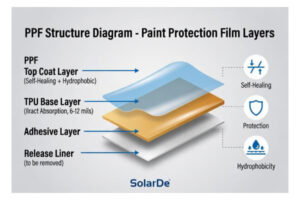
Aliphatic TPU generally costs more than conventional PVC or many TPH-type films. It is commonly selected for premium PPF because it can provide better elasticity, optical clarity and resistance to UV-related discoloration.
Lower-priced quotations may use aromatic TPU, modified PVC, TPH or a thinner substrate. Buyers should confirm the actual material rather than relying only on terms such as “premium TPU.” The differences between these materials are explained in SolarDe’s guide to TPU, TPH and PVC paint protection film materials.
2. Topcoat Technology
The topcoat influences stain resistance, gloss, hydrophobicity, surface smoothness and light-scratch recovery. More advanced coating systems normally increase manufacturing cost because they require controlled formulation, coating accuracy and curing conditions.
For example, 3M Paint Protection Film Series 100 combines polyurethane film with a self-healing surface designed to resist common automotive hazards. The presence of a similar feature should be supported by technical data rather than marketing language alone.
3. Adhesive Quality
A pressure-sensitive adhesive must balance initial tack, repositionability, final adhesion and clean removal. Higher-quality adhesive systems can reduce silvering, glue lines, edge lifting and residue complaints.
Adhesive cost may rise when the buyer requires stronger edge stability, low initial tack, low-temperature installation performance or long-term removal testing.
4. Film Thickness
Thicker film normally uses more raw material, but thickness should not be evaluated independently. A nominal 8.5 mil product is not automatically better than a 7.5 mil product if the thicker film has poorer clarity, coating durability or adhesive performance.
A quotation should clarify whether the stated thickness includes:
- The TPU or other base film;
- The topcoat;
- The adhesive;
- The release liner;
- Or only the installed film construction.
5. Clear, Matte or Color Finish
Clear gloss PPF is usually less expensive to produce than complex color, metallic, pearlescent or color-shifting films. Color PPF may require pigments, special TPU, additional coating controls and tighter batch-matching procedures.
Matte film also requires consistent surface texture and gloss control. Irregular coating can create visible differences between adjacent panels.
Why Does Professional PPF Installation Cost So Much?
Professional PPF installation prices include considerably more than the film itself. Labor often represents a major share of the total quotation because the finished appearance depends on preparation, pattern accuracy and installation skill.
Coverage Area
A bumper kit uses less film and labor than a full-front or full-body package. Full-vehicle installation may require multiple days of work and significantly more material.
Vehicle Size and Shape
A compact sedan is generally less expensive to cover than a large SUV, pickup truck or high-performance vehicle with wide body panels. Deep curves, vents, spoilers, sensors and complex bumper openings increase installation time.
Paint Preparation
The vehicle must be thoroughly cleaned and decontaminated before installation. Existing scratches, water spots or paint defects may require correction because PPF does not conceal every imperfection.
Disassembly and Edge Wrapping
Premium installations may involve removing badges, trim, lights, handles or other components so the film can be wrapped around edges. This produces a cleaner appearance but increases labor and reassembly responsibility.
Precut Pattern vs Bulk Installation
Precut software can reduce cutting on the vehicle and improve repeatability. Bulk installation may allow additional edge wrapping but requires more material and installer experience.
Installer Experience and Warranty
A trained installer with a controlled work environment normally charges more than an inexperienced installer. The higher price may include workmanship support, panel replacement policies and access to an authorized product warranty.
XPEL notes that professional installation is recommended for its paint protection products and provides product and warranty information through its official help center.
What Affects Wholesale PPF Prices?
Factory wholesale pricing is calculated differently from retail roll or installed prices. The unit price may decrease with volume, but a lower quotation is not necessarily a lower total purchasing cost.
| Wholesale Factor | How It Changes Price | What the Buyer Should Confirm |
|---|---|---|
| Order quantity | Larger orders may reduce coating, setup, packaging and handling costs per roll. | MOQ for stock products, custom specifications and custom colors. |
| Raw-material grade | Aliphatic TPU, premium adhesive and specialized topcoats normally cost more. | Material supplier, polymer type, grade consistency and traceability. |
| Roll dimensions | Wider, longer or nonstandard rolls use more material and may require special packaging. | Net film width, roll length, tolerance, core size and usable area. |
| Private labeling | Custom cartons, cores, labels, manuals and backing-paper printing add setup and production costs. | Artwork fees, minimum quantities, printing method and included revisions. |
| Custom color development | Color matching requires laboratory work, sampling and additional production controls. | Sample fees, approval process, color tolerance and minimum batch size. |
| Testing and certification | Independent testing and detailed quality documentation increase project cost. | Test methods, laboratory, sample identity and whether reports apply to the supplied specification. |
| Warranty requirements | Longer or broader warranty commitments increase expected claim and service costs. | Covered defects, excluded conditions, labor responsibility and claim procedure. |
| Trade terms | EXW, FOB, CIF and DDP quotations include different logistics responsibilities and costs. | Named port or place, freight, insurance, customs duties and destination charges. |
The ICC Incoterms® 2020 rules define how costs, transport obligations and risks are allocated between buyer and seller. A US$500 FOB quotation and a US$560 CIF quotation cannot be compared until the included services and destination are confirmed.
How to Compare PPF Wholesale Quotations
The most reliable comparison method is to calculate the landed cost of a usable, approved roll rather than comparing only the quoted price per roll.
A practical landed-cost calculation is:
Landed cost per roll = product price + packaging + inland transport + export charges + international freight + insurance + import duty + local delivery + expected defect or claim cost.
The cost per usable square meter can then be calculated as:
Cost per usable m² = total landed roll cost ÷ usable film area after defects, setup waste and installation waste.
Before accepting a quotation, request the following information:
- Exact material type, including whether the TPU is aliphatic or aromatic;
- Base-film, adhesive and total installed thickness;
- Roll width, length and production tolerances;
- Haze, gloss, tensile strength, elongation and peel-adhesion data;
- Accelerated-weathering method and measured results;
- Topcoat stain, chemical and scratch-recovery tests;
- MOQ for stock products and customized products;
- Packaging, private-label and color-development charges;
- Trade term, port, freight validity and payment conditions;
- Warranty scope, complaint procedure and replacement responsibility.
Optical and mechanical test data help explain why two visually similar rolls may have different prices. ASTM D1003 covers haze and luminous transmittance testing for transparent plastics, while ASTM D882 covers tensile properties of thin plastic sheeting.
Is Cheaper PPF Always More Profitable?
A lower purchase price can improve margins only when the film remains consistent during installation and service. A cheap roll becomes expensive when it causes excessive waste, difficult stretching, adhesive marks, edge lifting, customer complaints or early replacement.
For distributors and installers, the relevant cost is not simply the purchase price. It is the cost of supplying a successful installation.
Consider the following example:
- Roll A costs less but produces high installation waste and frequent edge failures.
- Roll B costs more but installs predictably and generates fewer warranty claims.
- The initial gross margin may appear higher for Roll A, while the final net margin may be better for Roll B.
Sample rolls should therefore be tested on flat panels, bumpers, deep curves, edges and dark paint before a large order is placed. Buyers should also compare more than one production batch.
How SolarDe Calculates a PPF Quotation
SolarDe develops quotations according to the actual product and market requirements rather than using one price for every PPF roll. Relevant details include:
- Clear, matte, black, metallic or color PPF;
- TPU grade and target product positioning;
- Film and adhesive thickness;
- Gloss, haze, hydrophobicity and self-healing requirements;
- Roll size and core specification;
- Order quantity and repeat-order plan;
- Private-label cartons, labels and backing-paper printing;
- Required test documents and warranty term;
- Destination country, port and Incoterm.
Distributors can review SolarDe’s clear paint protection film range and OEM and ODM automotive film services before requesting samples or bulk pricing.
Conclusion
PPF price depends on whether the quotation covers raw film, a retail roll, a precut kit or professional installation. Retail 60-inch master rolls may cost more than US$1,000, while complete vehicle installation can reach several thousand dollars. Wholesale buyers should compare the substrate, topcoat, adhesive, dimensions, MOQ, packaging, test data, warranty and landed cost—not just the price per roll. A technically consistent film may produce better long-term margins by reducing waste, installation problems and warranty claims.
Frequently Asked Questions
How much does a full roll of PPF cost?
Public U.S. retail prices for a 60 in × 50 ft branded PPF roll commonly exceed US$1,000, with some premium clear, matte or color products priced above US$1,400. Direct factory wholesale prices depend on the specification and order quantity.
How much does full-front PPF installation cost?
A full-front professional installation in the United States may cost approximately US$1,500–US$3,500. Vehicle size, bumper complexity, film brand, preparation and installer experience can move the final price outside this range.
Why does full-car PPF cost more than a vinyl wrap?
PPF is generally thicker and more difficult to install than conventional vinyl wrap. Full-body PPF also requires extensive surface preparation, complex panel fitting, more expensive material and skilled labor.
Does thicker PPF always cost more?
Thicker film normally uses more material, but price also depends on TPU grade, coating, adhesive and production quality. A thicker product is not automatically a better product.
How does order quantity affect wholesale PPF price?
Larger orders may reduce setup, coating, packaging and handling costs per roll. Custom colors, printed liners and private-label packaging usually have higher minimum quantities than stock clear PPF.
What information is needed for an accurate wholesale quotation?
The supplier needs the PPF type, material, thickness, roll size, quantity, packaging, branding, test requirements, warranty, destination and preferred trade term.
Should I compare PPF suppliers by price per roll?
No. Compare landed cost per usable square meter together with installation waste, batch consistency, warranty risk and expected complaint cost.
How can I request a SolarDe PPF price?
Contact SolarDe with your target film type, thickness, roll size, quantity, private-label requirements and destination. The team can prepare a specification-based quotation and sample plan.