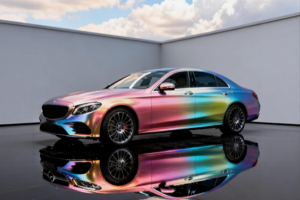
Paint protection film is not one single product. Buyers can choose transparent film that preserves the original paint, satin or matte film that changes surface sheen, and colored or metallic film that combines protection with restyling. For installers and distributors, the useful question is not simply which type looks best. The better question is which construction, finish and product position match the customer, installation process and local market.
This guide separates the main paint protection film types by appearance and buying purpose. It also explains which specifications should be checked before choosing a film for professional installation, wholesale inventory or private-label development.
Start With the Two Main PPF Buying Decisions
Most PPF selection begins with two decisions: whether the vehicle should keep its original paint appearance, and whether the project is primarily protection or protection plus restyling. SolarDe groups its automotive range into clear and color options on its paint protection film product and wholesale hub.
- Preserve the original appearance: start with clear PPF and compare gloss, thickness, topcoat and mechanical data.
- Change the appearance: compare satin, matte, solid color, metallic and specialty finishes while also checking installation behavior and batch consistency.

Clear Paint Protection Film
Clear PPF is designed to protect painted surfaces without introducing a new body color. It is commonly used on full fronts, full vehicles and high-impact areas where owners want the original paint to remain visible.
Clear does not mean every product performs the same way. Film construction can differ in substrate, topcoat, adhesive, thickness, gloss and warranty. Buyers should review the complete specification rather than treating the words “clear PPF” as a quality grade.
SolarDe publishes thickness, surface gloss, tensile strength, tear strength and warranty information across multiple series in its clear PPF range. Those fields are more useful for product comparison when they are considered together, not as isolated numbers.
When clear PPF is a practical choice
- The customer wants protection without changing the original paint color.
- The installer needs a transparent film with a defined thickness and coating specification.
- A distributor wants a core PPF category that can serve detailing shops and mainstream protection packages.
- A private-label program needs a transparent product line that can be positioned by performance tier.
Satin PPF
Satin PPF creates a soft, low-sheen appearance while adding a protective film layer. It sits visually between a bright gloss and a very flat matte effect, although manufacturers may use finish names differently. Buyers should therefore compare real samples and measured product information instead of assuming that every “satin” film has the same sheen.
Satin is especially relevant when the vehicle owner wants a more understated restyling effect without moving to a high-gloss color change. The category can include neutral colors, dark finishes and specialty shades. SolarDe’s satin PPF range provides a dedicated product path for this finish family.
What to check before stocking satin film
- Color and sheen consistency across adjacent panels.
- How the surface looks under daylight, indoor lighting and curved reflections.
- Stretch and adhesive behavior on bumpers, mirrors and deep contours.
- Edge appearance after installation.
- Batch identification for repeat orders.
Matte PPF
Matte PPF reduces reflected light more strongly than a typical satin finish. It can be used either to transform the appearance of gloss paint or to protect an existing matte surface, depending on the product and vehicle. The words matte and satin should not be treated as interchangeable technical specifications because visual sheen can vary by formulation and measurement method.
For matte applications, installers should pay particular attention to surface uniformity. A small change in texture or sheen may be more visible across neighboring panels than it would be on a high-gloss surface. Sample installation is therefore useful before committing to a complete vehicle or a wholesale batch.
Metallic PPF
Metallic PPF adds a reflective or metal-inspired visual effect while retaining the thicker protective-film concept of PPF. The appearance depends on color, particle or optical effect, coating and viewing angle. It is a restyling-led category and should be evaluated on the vehicle, not only from a small color swatch.
Distributors considering metallic ppf should ask how the supplier controls color consistency, how replacement rolls are identified and how the finish behaves when stretched. Those questions are important because a complex visual effect can expose panel-to-panel differences more easily than a conventional clear film.
Solid and Specialty Color PPF
Color PPF combines surface protection with a visible color change. It can serve drivers who want a different appearance without separating the styling layer from the protective layer. Product families can include solid colors, gloss colors, satin colors, metallic effects and other specialty finishes.
For a distributor, color PPF should be treated as a managed assortment rather than an unlimited color catalog. A smaller set of reliable colors with controlled repeat supply can be more useful than dozens of shades that are difficult to replenish consistently.
PPF Type Is Different From PPF Material
Finish and material describe different things. “Clear,” “satin” and “metallic” describe appearance categories. “TPU,” “TPH” and “PVC” describe material families or constructions used in protective films. A buyer should not use one label as a substitute for the other.
For more detail on film construction, review SolarDe’s PPF material guide. The most useful purchase specification combines material, coating, adhesive, thickness, finish, mechanical data, warranty and intended application.
How Installers Should Compare Paint Protection Film Types
- Define the appearance goal. Decide whether the vehicle should stay visually original or receive a new finish.
- Choose a product family. Narrow the options to clear, satin, matte, metallic or another color category.
- Review the specification. Confirm thickness, construction, topcoat, adhesive and available test data.
- Install a sample. Test handling on flat panels, curves, edges and high-tension areas instead of judging only from a loose sheet.
- Inspect the finish under several lighting conditions. This is particularly important for satin, matte and metallic products.
- Confirm repeat-order identification. Distributors should know how product series and batches are tracked before building inventory.
How Distributors Should Build a PPF Range
A practical distributor portfolio can cover customer needs without creating unnecessary inventory. One approach is to establish a core clear PPF line, then add selected satin, matte or color products based on installer demand. Specialty finishes can be introduced after sample testing and market validation.
For wholesale programs, the same product name should map to a stable specification. Record the agreed film series, thickness, roll dimensions, finish, packaging and branding details before repeat orders. If private labeling is required, SolarDe’s OEM, ODM and OBM services describe the available customization path.
Frequently Asked Questions
What are the main types of paint protection film?
Common appearance categories include clear, gloss color, satin, matte, metallic and other specialty color PPF. The exact range varies by manufacturer.
Is clear PPF always glossy?
No. Transparent film can be produced with different surface finishes. Buyers should check the actual product specification and sample rather than assume that all clear PPF is high gloss.
What is the difference between satin PPF and matte PPF?
Satin generally has a softer sheen with more reflected light than a very flat matte finish, but naming and gloss levels vary. A side-by-side sample is the best way to compare two specific products.
Does metallic PPF protect paint like other PPF?
Metallic appearance describes the visual finish, not the complete protective specification. Protection depends on the film construction, coating, adhesive, thickness and verified product performance.
Which PPF type is best for wholesale inventory?
There is no universal answer. Start with the product types that match local installer demand and can be supplied consistently. Build the assortment around verified specifications, sample results and repeat-order requirements.
Conclusion
The right paint protection film type is a combination of appearance, construction, installation behavior and business fit. Clear PPF is the natural starting point when original paint appearance matters; satin, matte, metallic and color PPF add restyling options. Before placing a wholesale order, compare real samples and confirm the exact specification that will be used for repeat supply.
For product selection, samples or a specification-based quotation, review SolarDe’s PPF wholesale range and share your target finish, thickness, roll size, quantity and market requirements.